On this page
Bitbucket Cloud
This page covers how to configure Pipelines-as-Code with Bitbucket Cloud through a webhook. Use this method to run Tekton pipelines triggered by pull requests and push events on repositories hosted on bitbucket.org.
Prerequisites
- A running Pipelines-as-Code installation
- A Bitbucket Cloud API token or App Password (see below)
- The public URL of your Pipelines-as-Code controller route or ingress endpoint
Create a Bitbucket API Token
Follow this guide to create an API token.
Check these boxes to add the permissions to the token:
- read:workspace:bitbucket
- read:pullrequest:bitbucket
- read:repository:bitbucket
- write:repository:bitbucket
Store the generated token in a safe place, or you will have to recreate it.
Webhook Configuration using the CLI
Use the tkn pac create repo command to
configure a webhook and create the Repository CR in one step.
You need an App Password created. tkn pac uses this token to configure the webhook and stores it in a secret
in the cluster, which the Pipelines-as-Code controller uses for accessing the repository.
Below is the sample format for tkn pac create repo
$ tkn pac create repo

? Enter the Git repository url (default: https://bitbucket.org/workspace/repo):
? Please enter the namespace where the pipeline should run (default: repo-pipelines):
! Namespace repo-pipelines is not found
? Would you like me to create the namespace repo-pipelines? Yes
✓ Repository workspace-repo has been created in repo-pipelines namespace
✓ Setting up Bitbucket Webhook for Repository https://bitbucket.org/workspace/repo
? Please enter your bitbucket cloud username:  <username>
ℹ ️You now need to create a Bitbucket Cloud app password, please checkout the docs at https://is.gd/fqMHiJ for the required permissions
? Please enter the Bitbucket Cloud app password:  ************************************
👀 I have detected a controller url: https://pipelines-as-code-controller-openshift-pipelines.apps.awscl2.aws.ospqa.com
? Do you want me to use it? Yes
✓ Webhook has been created on repository workspace/repo
🔑 Webhook Secret workspace-repo has been created in the repo-pipelines namespace.
🔑 Repository CR workspace-repo has been updated with webhook secret in the repo-pipelines namespace
ℹ Directory .tekton has been created.
✓ A basic template has been created in /home/Go/src/bitbucket/repo/.tekton/pipelinerun.yaml, feel free to customize it.
ℹ You can test your pipeline by pushing the generated template to your git repository
Webhook Configuration (Manual)
If you prefer to configure the webhook yourself, follow these steps.
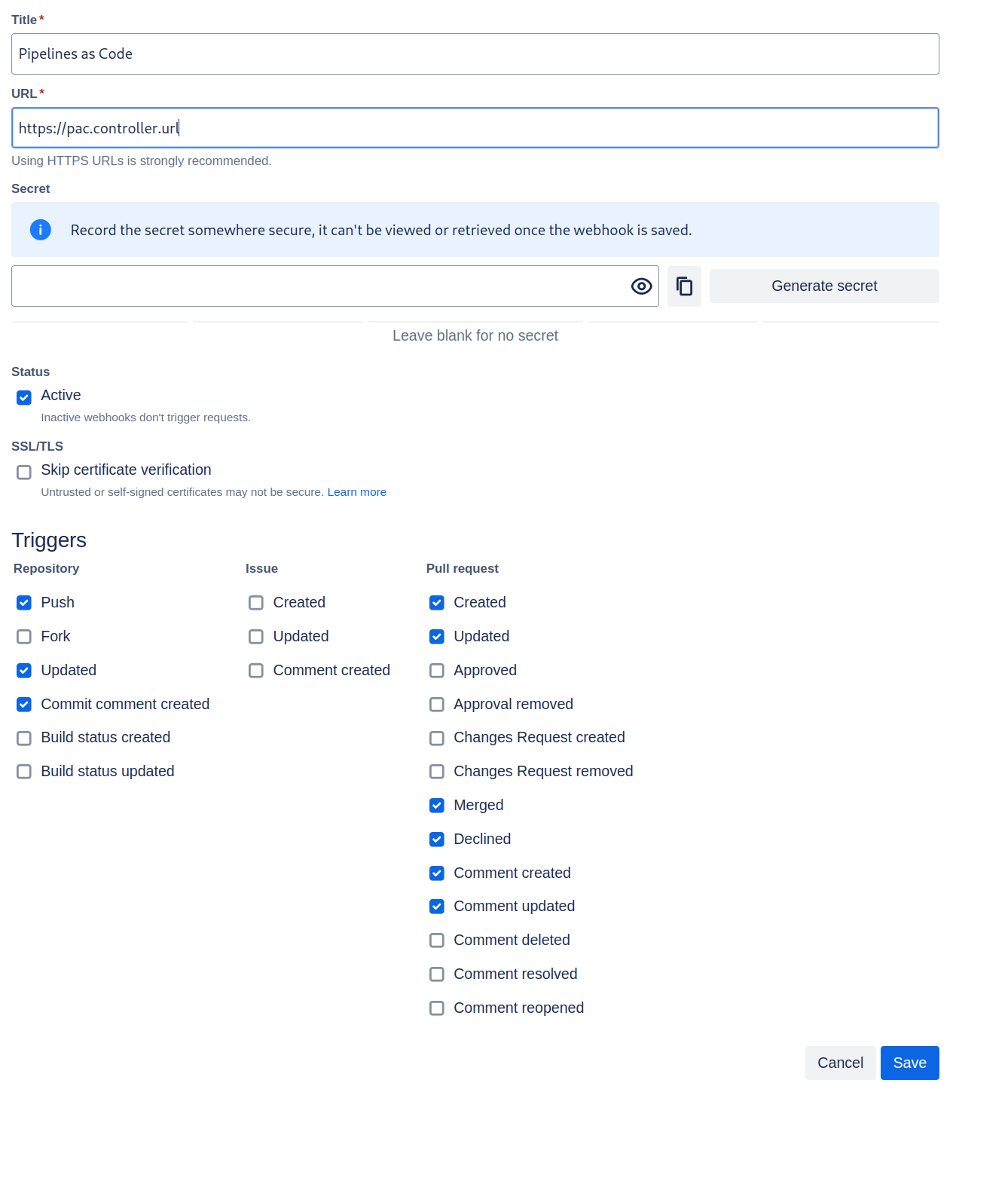
From the left navigation pane of your Bitbucket Cloud repository, go to Repository settings –> Webhooks tab and click on the Add webhook button.
Set a Title (i.e: Pipelines-as-Code)
Set the URL to the Pipelines-as-Code controller public URL. On OpenShift, get the public URL of the Pipelines-as-Code controller like this:
echo https://$(oc get route -n pipelines-as-code pipelines-as-code-controller -o jsonpath='{.spec.host}')The individual events to select are:
- Repository -> Push
- Repository -> Updated
- Repository -> Commit comment created
- Pull Request -> Created
- Pull Request -> Updated
- Pull Request -> Merged
- Pull Request -> Declined
- Pull Request -> Comment created
- Pull Request -> Comment updated
Refer to this screenshot to verify you have properly configured the webhook.
- Click on Save.
Create the Secret
Create a Kubernetes secret containing your App Password in the target-namespace (the namespace where your pipeline CI runs):
kubectl -n target-namespace create secret generic bitbucket-cloud-token \
        --from-literal provider.token="APP_PASSWORD_AS_GENERATED_PREVIOUSLY"
Create the Repository CR
Create a Repository CR with the secret field referencing it:
  ---
  apiVersion: "pipelinesascode.tekton.dev/v1alpha1"
  kind: Repository
  metadata:
    name: my-repo
    namespace: target-namespace
  spec:
    url: "https://bitbucket.com/workspace/repo"
    git_provider:
      user: "your_atlassian_email_id"
      secret:
        name: "bitbucket-cloud-token"
        # Set this if you have a different key in your secret
        # key: "provider.token"
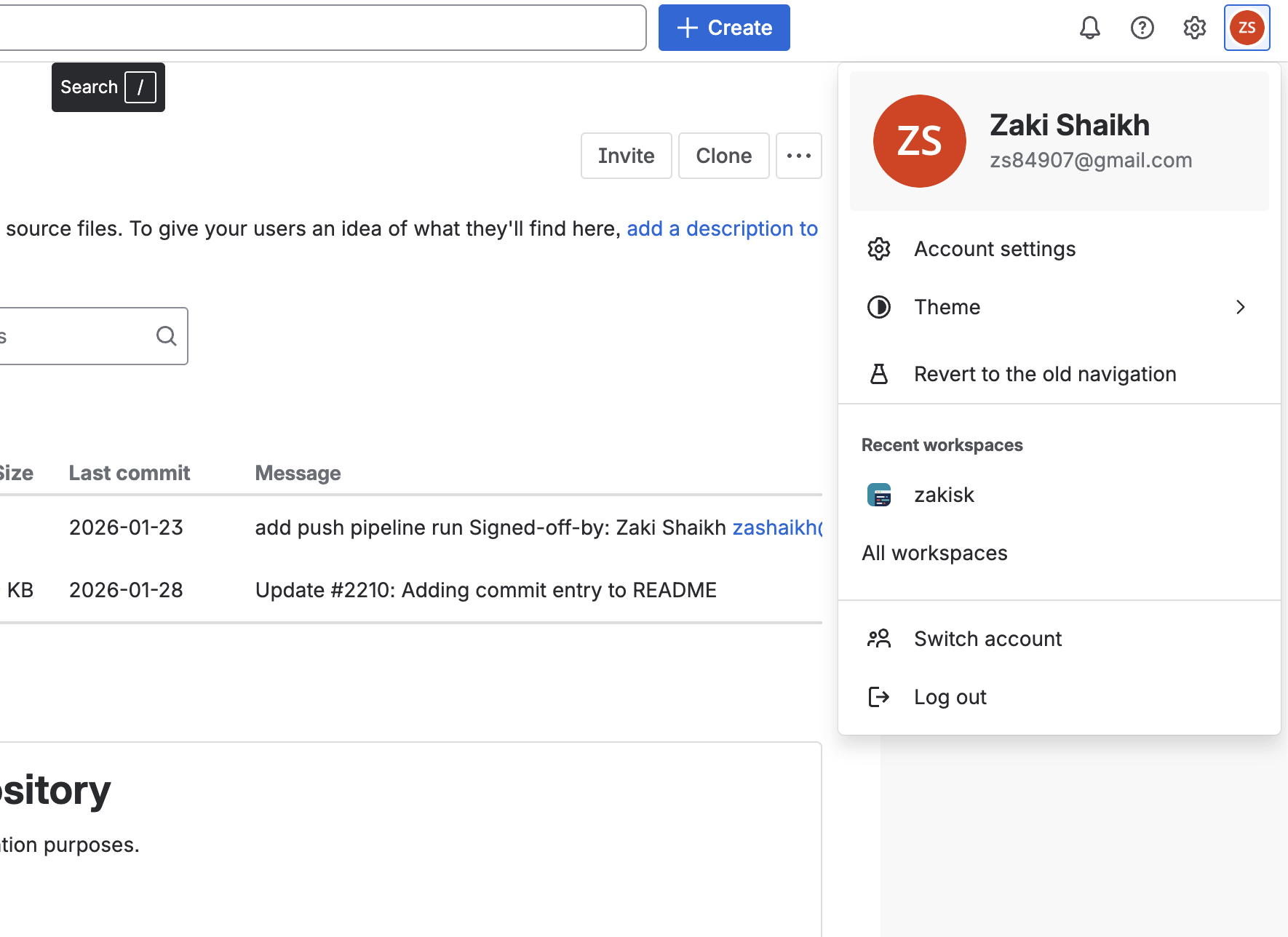
You must use your Bitbucket/Atlassian account email address in the user field of the Repository CR. To find your email address, click on your profile icon at the top-left corner in the Bitbucket Cloud UI (see image below), go to Account Settings, and scroll down to locate your email address.
Notes
The
git_provider.secretkey cannot reference a secret in another namespace. Pipelines-as-Code always assumes it is in the same namespace where the Repository CR has been created.The
tkn pac createandtkn pac bootstrapcommands are not supported on Bitbucket Cloud.
You can only reference a user by the ACCOUNT_ID in a owner file. For reason see here:
There is no webhook secret support in Bitbucket Cloud. To secure the payload and prevent hijacking of the CI, Pipelines-as-Code will fetch the IP addresses list from https://ip-ranges.atlassian.com/ and ensure that the webhook receptions come only from the Bitbucket Cloud IPs.
If you want to add some IP addresses or networks, you can add them to the
bitbucket-cloud-additional-source-ipkey in the pipelines-as-codeConfigMapin thepipelines-as-codenamespace. You can add multiple network or IPs separated by a comma.If you want to disable this behavior you can set the
bitbucket-cloud-check-source-ipkey tofalsein the pipelines-as-codeConfigMapin thepipelines-as-codenamespace.
Add Webhook Secret
If the webhook secret for an existing Repository CR has been deleted, or you want to add a new webhook to your project settings, use the tkn pac webhook add command. This command adds a webhook to the project repository settings and updates the webhook.secret key in the existing secret without modifying the Repository CR.
Below is the sample format for tkn pac webhook add
$ tkn pac webhook add -n repo-pipelines

✓ Setting up Bitbucket Webhook for Repository https://bitbucket.org/workspace/repo
? Please enter your bitbucket cloud username:  <username>
👀 I have detected a controller url: https://pipelines-as-code-controller-openshift-pipelines.apps.awscl2.aws.ospqa.com
? Do you want me to use it? Yes
✓ Webhook has been created on repository workspace/repo
🔑 Secret workspace-repo has been updated with webhook secret in the repo-pipelines namespace.Repository exists in a namespace other than the default namespace, use tkn pac webhook add [-n namespace].
In the above example, the Repository exists in the repo-pipelines namespace rather than the default namespace, so the webhook was added in the repo-pipelines namespace.Update Token
There are two ways to update the provider token for an existing Repository CR.
Update using the CLI
Use the tkn pac webhook update-token command to
update the provider token for an existing Repository CR.
Below is the sample format for tkn pac webhook update-token
$ tkn pac webhook update-token -n repo-pipelines

? Please enter your personal access token:  ************************************
🔑 Secret workspace-repo has been updated with new personal access token in the repo-pipelines namespace.Repository exists in a namespace other than the default namespace, use tkn pac webhook update-token [-n namespace].
In the above example, the Repository exists in the repo-pipelines namespace rather than the default namespace, so the webhook token was updated in the repo-pipelines namespace.Update using kubectl
When you have regenerated an app password, you must update it in the cluster. You can find the secret name in the Repository CR:
spec:
  git_provider:
    secret:
      name: "bitbucket-cloud-token"
Replace $password and $target_namespace with your values:
kubectl -n $target_namespace patch secret bitbucket-cloud-token -p "{\"data\": {\"provider.token\": \"$(echo -n $password|base64 -w0)\"}}"